Python 0917.py
class Solution:
    def reverseOnlyLetters(self, s: str) -> str:
        letters = [ c for c in s if "a" <= c.lower() <= "z" ]
        merged  = []
        for c in s:
            merged.append(letters.pop() if "a" <= c.lower() <= "z" else c)
        return "".join(merged)
Difficulty
This problem is ranked as
and has an acceptance rate of about 67% (300k+ submissions).
Typical patterns to solve this problem:
easy
medium
hard
and has an acceptance rate of about 67% (300k+ submissions).
Typical patterns to solve this problem:
- String
- Two Pointers
I solved 663 easy, 1250 medium and 309 hard problems
AI Disclaimer
Every single line of code was written by me, 100% from scratch, between August 2023 and August 2024.
However, two years later I set up this website and used various AI tools to generate most of the walkthrough / explanations below.
See this dedicated page for more details.
However, two years later I set up this website and used various AI tools to generate most of the walkthrough / explanations below.
See this dedicated page for more details.
Code Walkthrough
Overview
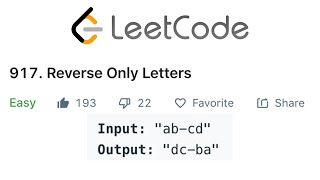
The provided implementation defines a Solution class with a single method reverseOnlyLetters. The method receives a string s and returns a new string where all alphabetic characters are reversed in order, while every non-alphabetic character remains in its original position. The algorithm works in two passes over the input: first it collects the letters, then it reconstructs the output by pulling letters from the end of that collection.
Key Steps
Collecting alphabetic characters
The first comprehension iterates over the input string and selects characters that satisfy the condition "a" <= c.lower() <= "z". This test treats both uppercase and lowercase letters uniformly by converting each character to lower case before the range check. The result is stored in the list letters.
letters = [c for c in s if "a" <= c.lower() <= "z"]Rebuilding the result while preserving non-letters
A second loop walks through the original string again. For each character it decides whether to place a letter from the end of the letters list or to keep the original character unchanged. The decision uses the same alphabetic test as before. When a letter is needed, letters.pop() removes and returns the last element, which corresponds to the next character in the reversed order.
merged = []
for c in s:
    merged.append(letters.pop() if "a" <= c.lower() <= "z" else c)
Producing the final string
After the loop finishes, the list merged contains the characters of the desired output in correct sequence. The method joins the list into a single string and returns it.
return "".join(merged)Edge Cases Handled
The algorithm naturally accommodates an empty input string. The list comprehension produces an empty letters list, the reconstruction loop does not execute any iterations, and the final join yields an empty string.
When the input consists solely of non-alphabetic symbols, the comprehension yields an empty letters list, and the reconstruction loop copies each original character unchanged, resulting in an output identical to the input.
If the string contains only letters, the letters list holds all characters, and each iteration of the reconstruction loop consumes one element via pop(). Because pop() removes from the end, the letters appear in reverse order in the final string.
Mixed-case letters are handled correctly because the test uses c.lower(). The original case of each letter is preserved because the actual character stored in letters is the original character, not its lower-cased version.
Strings with interleaved letters and symbols, such as "a-bC-dEf-ghIj", are processed by preserving the positions of the symbols (-, -, etc.) while reversing only the letters, exactly as required.
Performance Optimizations
The use of a list comprehension for the initial collection of letters creates the letters list in a single, efficient pass without intermediate data structures.
During reconstruction, the algorithm appends to a list merged rather than concatenating strings. List appends are amortized O(1) operations, avoiding the quadratic cost associated with repeated string concatenation in Python.
Retrieving letters with pop() from the end of the list is an O(1) operation, ensuring that each reversed character is accessed in constant time.
Finally, the conversion of the list of characters to a string with "".join(merged) is performed once, leveraging the highly optimized C implementation of join to produce the output efficiently.
written by openai gpt
ELI5 - Simplified Explanation
Imagine there is a box filled with mixed things like shiny letters and dusty rocks. This code starts by picking out all the letters and putting them into a neat pile. After that, it looks at the box again from the very beginning. Whenever it finds a spot that used to have a letter, it takes the very last letter from that pile and places it into that spot. If it finds a dusty rock, it just leaves the rock exactly where it was. By the time it finishes, all the letters have swapped places to be backwards while everything else stays perfectly still in its original home.
written by google gemini
Code Quality
Several LLMs ranked my code quality on a scale from 1 (very poor) to 10 (outstanding):
n = 26
|
median = 8
|
μ = 7.77
|
σ = 0.97
Complexity Analysis
Time: linear
As a rule of thumb, the maximum input size for one second execution time is
As a rule of thumb, the maximum input size for one second execution time is
- factorial: up to 10 elements
- exponential: up to 20 elements
- polynomial: a few thousand elements
- loglinear: up to 100,000 elements
- linear: a few million elements
- logarithmic: a billion elements
- constant: practically unlimited
generated automatically
Other Solutions
I wrote a basic crawler to find other solutions to that problem.
Obviously, I did that after I solved the problem myself.
In general, AlgoMonster and WalkCCC solutions are high-quality and always worth a look.
I haven't checked most of the other solutions, but they might be helpful as well.
And of course, the LeetCode forum is always a good place (or even the best) to look for alternative approaches.
(click on a column header to sort the table)
| author | |||||||||||
|---|---|---|---|---|---|---|---|---|---|---|---|
| author | solutions | ||||||||||
| www | AlgoMonster | C++ | Java | Python | TS | ||||||
| WalkCCC | C++ | Java | Python | ||||||||
| leetcode.ca | C++ | Java | Python | Go | Rust | TS | |||||
| LeetcodeHelp | C++ | Java | Python | ||||||||
| Progiez | C++ | Java | Python | ||||||||
| github | BigEggStudy | C# | |||||||||
| black-shadows | C++ | ||||||||||
| charles-wangkai | Java | ||||||||||
| DimitrisJim | C | ||||||||||
| everthis | JS | ||||||||||
| fartem | Ruby | ||||||||||
| fsq | C++ | ||||||||||
| JoshCrozier | JS | ||||||||||
| keineahnung2345 | C++ | ||||||||||
| Krazune | C++ | ||||||||||
| lkwq007 | Python | ||||||||||
| lzl124631x | C++ | ||||||||||
| suxrobGM | C# | ||||||||||
| varunu28 | Java | ||||||||||
| AlgoMonster | C++, Python, Java, TypeScript | ||||||||||
| WalkCCC | C++, Python, Java | ||||||||||
| leetcode.ca | C++, Go, Java, Python, Rust, TypeScript | ||||||||||
| LeetcodeHelp | C++, Java, Python | ||||||||||
| Progiez | C++, Java, Python | ||||||||||
| BigEggStudy | C# | ||||||||||
| black-shadows | C++, C++ | ||||||||||
| charles-wangkai | Java | ||||||||||
| DimitrisJim | C | ||||||||||
| everthis | JavaScript | ||||||||||
| fartem | Ruby | ||||||||||
| fsq | C++ | ||||||||||
| JoshCrozier | JavaScript | ||||||||||
| keineahnung2345 | C++ | ||||||||||
| Krazune | C++ | ||||||||||
| lkwq007 | Python | ||||||||||
| lzl124631x | C++ | ||||||||||
| suxrobGM | C# | ||||||||||
| varunu28 | Java |
33 links
|
19 authors
|
10 languages
Videos
These are a few popular YouTube videos for this problem:



Nick White 8 mins
LeetCode Reverse Only Letters Solution Explained - Java
Technosage 8 mins
Reverse only letters | Leetcode 917
CodeGPT 11 mins
LeetCode 917 : Reverse Only Letters || EASY || C++ || JAVA || Detailed Solution
Alexandr Kazakov 27 mins
[RU] LeetCode 917 Reverse Only Letters [JavaScript]
4 videos
did my crawler come up with invalid videos ? drop me a line.
Similar Problems
- problem 2810: Faulty Keyboard
1 similar problem
Solved On The Same Day
1 easy
- problem 888: Fair Candy Swap
- problem 799: Champagne Tower
- problem 846: Hand of Straights
- problem 853: Car Fleet
5 solutions
October 25, 2023
Extra
There are a few extra pages giving you some insights into my setup:
- Tech Stack - my development environment and tools
- AI - how AI helped me create this website (NOT solving the problems)
- Progress - progression over time
- Quality - code quality