Python 0938.py
class Solution:
    def rangeSumBST(self, root: Optional[TreeNode], low: int, high: int) -> int:
        def deeper(node):
            if not node:
                return 0

            children = deeper(node.left) + deeper(node.right)
            if node.val >= low and node.val <= high:
                return children + node.val
            else:
                return children

        return deeper(root)
Difficulty
This problem is ranked as
and has an acceptance rate of about 88% (1+ million submissions).
Typical patterns to solve this problem:
easy
medium
hard
and has an acceptance rate of about 88% (1+ million submissions).
Typical patterns to solve this problem:
- Binary Search Tree
- Binary Tree
- Depth First Search
- Tree
I solved 663 easy, 1250 medium and 309 hard problems
AI Disclaimer
Every single line of code was written by me, 100% from scratch, between August 2023 and August 2024.
However, two years later I set up this website and used various AI tools to generate most of the walkthrough / explanations below.
See this dedicated page for more details.
However, two years later I set up this website and used various AI tools to generate most of the walkthrough / explanations below.
See this dedicated page for more details.
Code Walkthrough
Overview
The provided implementation defines a class Solution with a method rangeSumBST that computes the sum of all node values within a given inclusive range [low, high] in a binary search tree (BST). The core logic is encapsulated in a nested helper function deeper, which performs a depth-first traversal of the tree, accumulating values that satisfy the range condition.
Core Traversal Logic
def deeper(node):
    if not node:
        return 0

    children = deeper(node.left) + deeper(node.right)
    if node.val >= low and node.val <= high:
        return children + node.val
    else:
        return children
The helper receives a single node. The first conditional checks for a null reference, which terminates the recursion and contributes zero to the sum. The next line recursively explores both left and right sub-trees, storing the combined result in children. After the recursive calls return, the current node’s value is examined against the bounds low and high. If the value lies inside the interval, it is added to children; otherwise, only the accumulated sum from the descendants is returned.
Entry Point
return deeper(root)The public method simply invokes deeper with the root of the BST, initiating the recursive descent.
Edge Cases Handled
When the tree is empty (root is None), the initial call to deeper immediately hits the null check and returns 0, correctly representing an empty sum.
If all node values fall outside the specified range, the condition node.val >= low and node.val <= high never evaluates to true, and the function propagates the sum of zero from each leaf upward, ultimately yielding 0.
When the range boundaries coincide (low == high), the algorithm still correctly includes only nodes whose value exactly matches that single bound, because the inclusive comparison covers equality on both sides.
The recursion naturally accommodates highly unbalanced trees, as each node is visited exactly once regardless of shape, ensuring that even degenerate structures (e.g., a linked-list-like chain) are processed without special handling.
Implicit Performance Optimizations
The implementation leverages a post-order traversal pattern: it first aggregates results from the left and right sub-trees before deciding whether to incorporate the current node’s value. This ordering allows the function to reuse the already computed sums (children) without additional data structures, keeping the memory footprint limited to the call stack.
Because the algorithm does not store intermediate results in auxiliary containers (such as lists or queues), it avoids the overhead of dynamic memory allocation during traversal. The use of a single integer accumulator (children) per call minimizes temporary objects and contributes to faster execution.
The recursion terminates early for null children, preventing unnecessary work on absent sub-trees. Although the code does not explicitly prune branches based on BST ordering properties, the straightforward depth-first approach ensures each node is examined exactly once, which is optimal for a full traversal scenario.
Summary of Execution Flow
The method begins at the root, recursively descends to leaf nodes, aggregates sums from sub-trees, checks each node against the range, and bubbles the partial sums upward. The final integer returned by rangeSumBST represents the total of all node values that satisfy the inclusive range condition.
written by openai gpt
ELI5 - Simplified Explanation
Imagine a big family tree made of numbers where everyone has a special place. Each person in the tree is holding a number. This code is like a curious little explorer whose job is to find all the numbers that are tucked inside a specific range.
The explorer starts at the very top of the tree, which is called the root. When the explorer reaches someone, they check if that person is even there. If the spot is empty, the explorer just keeps moving. If there is a person, the explorer checks the numbers held by the people to the left and to the right in the tree.
After checking the family members below, the explorer looks at the number held by the person they are currently visiting. If that number is not too small and not too big, it fits perfectly inside the target range. The explorer adds that number to the pile they have been collecting from the children. If the number is outside of the range, the explorer simply moves on without adding it to the pile. This keeps happening until every single branch of the tree has been visited and the total count has been counted.
written by google gemini
Code Quality
Several LLMs ranked my code quality on a scale from 1 (very poor) to 10 (outstanding):
n = 26
|
median = 8
|
μ = 7.23
|
σ = 1.34
Complexity Analysis
Time: linear
As a rule of thumb, the maximum input size for one second execution time is
As a rule of thumb, the maximum input size for one second execution time is
- factorial: up to 10 elements
- exponential: up to 20 elements
- polynomial: a few thousand elements
- loglinear: up to 100,000 elements
- linear: a few million elements
- logarithmic: a billion elements
- constant: practically unlimited
generated automatically
Other Solutions
I wrote a basic crawler to find other solutions to that problem.
Obviously, I did that after I solved the problem myself.
In general, AlgoMonster and WalkCCC solutions are high-quality and always worth a look.
I haven't checked most of the other solutions, but they might be helpful as well.
And of course, the LeetCode forum is always a good place (or even the best) to look for alternative approaches.
(click on a column header to sort the table)
| author | |||||||||||
|---|---|---|---|---|---|---|---|---|---|---|---|
| author | solutions | ||||||||||
| www | AlgoMonster | C++ | Python | Java | TS | ||||||
| WalkCCC | C++ | Java | |||||||||
| leetcode.ca | C++ | Python | Java | C# | Go | TS | |||||
| LeetcodeHelp | C++ | Python | Java | ||||||||
| Progiez | C++ | Python | Java | ||||||||
| github | BigEggStudy | C# | |||||||||
| black-shadows | C++ | ||||||||||
| chandansgowda | Python | ||||||||||
| charles-wangkai | Java | ||||||||||
| DimitrisJim | C | ||||||||||
| everthis | JS | ||||||||||
| fartem | Ruby | ||||||||||
| fengvyi | C++ | ||||||||||
| fsq | C++ | ||||||||||
| halfrost | Go | ||||||||||
| JoshCrozier | JS | ||||||||||
| keineahnung2345 | C++ | ||||||||||
| Krazune | C | ||||||||||
| lkwq007 | Python | ||||||||||
| muhammadfarhankt | Go | ||||||||||
| shreymehul | C# | ||||||||||
| suxrobGM | C# | ||||||||||
| varunu28 | Java | ||||||||||
| vthwang | Java | ||||||||||
| yuanliu666 | Kotlin | ||||||||||
| YuriSpiridonov | Python | ||||||||||
| AlgoMonster | C++, Python, Java, TypeScript | ||||||||||
| WalkCCC | C++, Java | ||||||||||
| leetcode.ca | C++, C#, Go, Java, Python, TypeScript | ||||||||||
| LeetcodeHelp | C++, Java, Python | ||||||||||
| Progiez | C++, Java, Python | ||||||||||
| BigEggStudy | C# | ||||||||||
| black-shadows | C++, C++ | ||||||||||
| chandansgowda | Python | ||||||||||
| charles-wangkai | Java | ||||||||||
| DimitrisJim | C | ||||||||||
| everthis | JavaScript | ||||||||||
| fartem | Ruby | ||||||||||
| fengvyi | C++ | ||||||||||
| fsq | C++ | ||||||||||
| halfrost | Go | ||||||||||
| JoshCrozier | JavaScript | ||||||||||
| keineahnung2345 | C++ | ||||||||||
| Krazune | C | ||||||||||
| lkwq007 | Python | ||||||||||
| muhammadfarhankt | Go | ||||||||||
| shreymehul | C# | ||||||||||
| suxrobGM | C# | ||||||||||
| varunu28 | Java | ||||||||||
| vthwang | Java | ||||||||||
| yuanliu666 | Kotlin | ||||||||||
| YuriSpiridonov | Python |
39 links
|
26 authors
|
10 languages
Videos
These are a few popular YouTube videos for this problem:
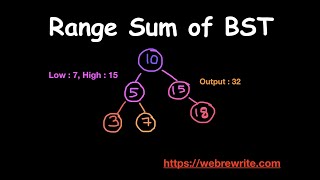


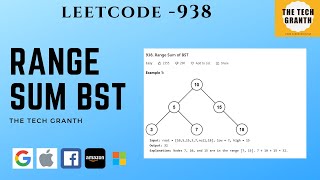
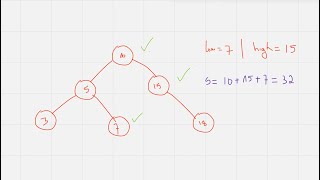
Programming Tutorials 14 mins
Range Sum of BST | LeetCode 938
Developer Docs 8 mins
Leetcode | 938. Range Sum of BST | Easy | Java Solution
Deepti Talesra 13 mins
Range Sum of BST - LeetCode 938 - Python #binarytree #binarysearchtree #leetcode
Coding Decoded 6 mins
Range Sum of BST | Leetcode 938 | Live coding session 🔥🔥🔥🔥 | O(n)
cpwithcpp 5 mins
Range Sum of BST | 08 Jan POTD | Leetcode Problem of the Day
The Tech Granth 7 mins
Leetcode 938 | Range Sum of Binary Search Tree(BST) | Range Sum of BST (Detailed solution)
InterviewDose 5 mins
Leetcode 938. Range Sum of BST in better than O(N) Time
Adi Explains 9 mins
Range Sum of BST | Binary Search Tree | Leetcode | in தமிழ்
SoftWiz Circle 5 mins
Range Sum of BST | LeetCode 938 | Tree Problem
The algorithm Architect 6 mins
LeetCode 938: ✅ C++ Range Sum of BST
10 videos
did my crawler come up with invalid videos ? drop me a line.
Similar Problems
- problem 1973: Count Nodes Equal to Sum of Descendants
1 similar problem
Solved On The Same Day
2 easy
- problem 563: Binary Tree Tilt
- problem 965: Univalued Binary Tree
- problem 146: LRU Cache
- problem 371: Sum of Two Integers
- problem 865: Smallest Subtree with all the Deepest Nodes
- problem 1201: Ugly Number III
- problem 2707: Extra Characters in a String
8 solutions
September 2, 2023
Extra
There are a few extra pages giving you some insights into my setup:
- Tech Stack - my development environment and tools
- AI - how AI helped me create this website (NOT solving the problems)
- Progress - progression over time
- Quality - code quality