C++ 0096.cpp
class Solution {
public:
    int numTrees(int n) {
        // problem 95 identified this as Catalan numbers
        // https://www.wolframalpha.com/input?i=1%2C2%2C5%2C14%2C42%2C132%2C429
        vector<int64_t> result =
        {
            1, 2, 5, 14, 42, 132, 429, 1430, 4862, 16796, 58786, 208012, 742900, 2674440, 9694845, 35357670, 129644790, 477638700, 1767263190, 6564120420, 24466267020, 91482563640, 343059613650, 1289904147324, 4861946401452, 18367353072152, 69533550916004, 263747951750360 };

        return result[n - 1];

    }
}
Difficulty
This problem is ranked as
and has an acceptance rate of about 64% (1+ million submissions).
Typical patterns to solve this problem:
easy
medium
hard
and has an acceptance rate of about 64% (1+ million submissions).
Typical patterns to solve this problem:
- Binary Search Tree
- Binary Tree
- Dynamic Programming
- Math
- Tree
I solved 663 easy, 1250 medium and 309 hard problems
AI Disclaimer
Every single line of code was written by me, 100% from scratch, between August 2023 and August 2024.
However, two years later I set up this website and used various AI tools to generate most of the walkthrough / explanations below.
See this dedicated page for more details.
Code Walkthrough
Overview
The provided implementation defines a Solution class with a single public method numTrees. The method computes the number of distinct binary search trees that can be formed with n distinct keys. Rather than calculating the value dynamically, it stores a pre-computed sequence of Catalan numbers in a vector<int64_t> and returns the element that corresponds to the requested size.
Core Logic
The heart of the algorithm is the static lookup table. The vector is initialized with a literal list of Catalan numbers ranging from the first value (for n = 1) up to the twenty-eighth value (for n = 28). The method accesses the element at index n-1 and returns it directly.
vector<int64_t> result = {
    1, 2, 5, 14, 42, 132, 429, 1430, 4862, 16796,
    58786, 208012, 742900, 2674440, 9694845, 35357670,
    129644790, 477638700, 1767263190, 6564120420,
    24466267020, 91482563640, 343059613650, 1289904147324,
    4861946401452, 18367353072152, 69533550916004,
    263747951750360
};
The return statement extracts the appropriate entry:
return result[n - 1];Edge Cases Handled
The function implicitly handles the smallest valid input (n = 1). In this case the index calculation n-1 yields zero, and the first element of the vector (1) is returned, which correctly represents the single possible BST for one node. Because the vector is sized to contain entries for n up to 28, any call with n in the range [1, 28] will safely index the vector without out-of-bounds access. The use of a 64-bit integer type (int64_t) accommodates the large values that appear in the later part of the sequence, preventing overflow for the supported range.
Performance Optimizations
The most significant optimization is the elimination of any runtime computation. By storing the Catalan numbers ahead of time, the method reduces the work to a constant-time array access and a single subtraction for the index. This yields an O(1) execution path regardless of the input size. The vector is constructed once per call, but because the initializer list is a compile-time constant, modern compilers can place the data in read-only memory, effectively treating it as a static array. This avoids dynamic memory allocation and the overhead of iterative or recursive Catalan number formulas. The choice of int64_t ensures that the values fit within the native word size of most 64-bit architectures, allowing the processor to handle arithmetic and memory operations efficiently.
Overall, the implementation provides an immediate answer for any supported n with minimal computational expense.
written by openai gpt
ELI5 - Simplified Explanation
Imagine you have a big box of special building blocks. These blocks are very clever because they know exactly how to fit together to build many different tree shapes. Some shapes are tall and skinny like a pine branch, while others are short and wide like a bushy oak.
The code looks at a secret list that was written down by a very smart person. This list tells us exactly how many different ways those building blocks can be arranged. If you want to know how many trees you can build, you just tell the computer how many blocks you have. The code looks at the number you give it, finds that number in its secret list, and shows you the answer written right next to it. It is like having a magic book that tells you all the possible ways to build your tree garden before you even start playing.
written by google gemini
Code Quality
Several LLMs ranked my code quality on a scale from 1 (very poor) to 10 (outstanding):
n = 27
|
median = 5
|
μ = 5.63
|
σ = 2.84
Complexity Analysis
Time: constant
As a rule of thumb, the maximum input size for one second execution time is
As a rule of thumb, the maximum input size for one second execution time is
- factorial: up to 10 elements
- exponential: up to 20 elements
- polynomial: a few thousand elements
- loglinear: up to 100,000 elements
- linear: a few million elements
- logarithmic: a billion elements
- constant: practically unlimited
generated automatically
Other Solutions
I wrote a basic crawler to find other solutions to that problem.
Obviously, I did that after I solved the problem myself.
In general, AlgoMonster and WalkCCC solutions are high-quality and always worth a look.
I haven't checked most of the other solutions, but they might be helpful as well.
And of course, the LeetCode forum is always a good place (or even the best) to look for alternative approaches.
(click on a column header to sort the table)
| author | ||||||||||||
|---|---|---|---|---|---|---|---|---|---|---|---|---|
| author | solutions | |||||||||||
| www | AlgoMonster | C++ | Python | Java | TS | |||||||
| WalkCCC | C++ | Python | Java | |||||||||
| leetcode.ca | C++ | Python | C# | Java | Rust | Go | TS | |||||
| LeetcodeHelp | C++ | Python | Java | |||||||||
| MemoryLimitExceeded | C++ | Python | ||||||||||
| Progiez | C++ | Python | Java | |||||||||
| github | aylei | Rust | ||||||||||
| begeekmyfriend | C | |||||||||||
| BigEggStudy | C# | |||||||||||
| black-shadows | Python | |||||||||||
| charles-wangkai | Java | |||||||||||
| chenyanzhe | C++ | |||||||||||
| everthis | JS | |||||||||||
| fartem | Ruby | |||||||||||
| FelixFan1122 | C# | |||||||||||
| fpdjsns | C++ | |||||||||||
| gaosq0604 | Python | |||||||||||
| gouthampradhan | Java | |||||||||||
| halfrost | Go | |||||||||||
| haoel | C++ | |||||||||||
| JoshCrozier | JS | |||||||||||
| keineahnung2345 | C++ | |||||||||||
| lennylxx | C | |||||||||||
| linouk23 | C++ | |||||||||||
| lkwq007 | Python | |||||||||||
| luangong | C++ | |||||||||||
| MacJim | C++ | |||||||||||
| martianoff | Scala | |||||||||||
| qiyuangong | Python | |||||||||||
| ruoru | Rust | |||||||||||
| shreymehul | C# | |||||||||||
| sonugiri1043 | C++ | |||||||||||
| suxrobGM | C# | |||||||||||
| varunu28 | Java | |||||||||||
| vli02 | C | |||||||||||
| wisdompeak | C++ | |||||||||||
| zfang399 | C++ | |||||||||||
| AlgoMonster | C++, Python, Java, TypeScript | |||||||||||
| WalkCCC | C++, Python, Java | |||||||||||
| leetcode.ca | C++, C#, Go, Java, Python, Rust, TypeScript | |||||||||||
| LeetcodeHelp | C++, Java, Python | |||||||||||
| MemoryLimitExceeded | Python, C++ | |||||||||||
| Progiez | C++, Java, Python | |||||||||||
| aylei | Rust | |||||||||||
| begeekmyfriend | C | |||||||||||
| BigEggStudy | C# | |||||||||||
| black-shadows | Python, Python | |||||||||||
| charles-wangkai | Java | |||||||||||
| chenyanzhe | C++ | |||||||||||
| everthis | JavaScript | |||||||||||
| fartem | Ruby | |||||||||||
| FelixFan1122 | C# | |||||||||||
| fpdjsns | C++ | |||||||||||
| gaosq0604 | Python | |||||||||||
| gouthampradhan | Java | |||||||||||
| halfrost | Go | |||||||||||
| haoel | C++ | |||||||||||
| JoshCrozier | JavaScript | |||||||||||
| keineahnung2345 | C++ | |||||||||||
| lennylxx | C | |||||||||||
| linouk23 | C++ | |||||||||||
| lkwq007 | Python | |||||||||||
| luangong | C++ | |||||||||||
| MacJim | C++ | |||||||||||
| martianoff | Scala | |||||||||||
| qiyuangong | Python | |||||||||||
| ruoru | Rust | |||||||||||
| shreymehul | C# | |||||||||||
| sonugiri1043 | C++ | |||||||||||
| suxrobGM | C# | |||||||||||
| varunu28 | Java | |||||||||||
| vli02 | C | |||||||||||
| wisdompeak | C++ | |||||||||||
| zfang399 | C++ |
53 links
|
37 authors
|
11 languages
Videos
These are a few popular YouTube videos for this problem:








Techdose 8 mins
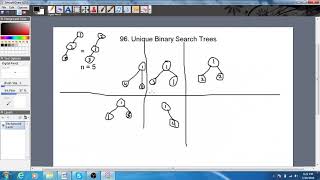
Unique Binary Search Trees | Count all structurally unique BSTs | Catalan number | Leetcode #96
Knowledge Center 17 mins
Count Unique Binary Search Trees | LeetCode 96 | C++, Java, Python | Catalan Number
basketwangCoding 8 mins
[Leetcode 96] Unique Binary Search Tree
Sai Anish Malla 20 mins
Unique Binary Search Trees II | LeetCode 95 | Theory + Python code
Timothy H Chang 10 mins
Leetcode - Unique Binary Search Trees (Python)
Naresh Gupta 12 mins
unique binary search trees | unique binary search trees leetcode | leetcode 96 | recursive | top dow
Coding Decoded 12 mins
Dp on Trees | Unique Binary Search Trees | Leetcode 96 | Live coding session🔥 | Dynamic Programming
Happy Coding 20 mins
LeetCode 96. Unique Binary Search Trees
Alex Solves Algorithms 8 mins
Leetcode Question 96. Unique Binary Search Trees Solution (With Code In Java)
Mykola 19 mins
Attempting Leetcode (Question 96: Unique Binary Search Trees)
Programming Live with Larry 10 mins
Daily Leetcode #587: Nov 08, 2021 - 96. Unique Binary Search Trees
Programming Live with Larry 9 mins
Daily Leetcode #85: Jun 24, 2020 - 96. Unique Binary Search Trees
Sleepy Cracker 15 mins
LeetCode 96 | Unique Binary Search Trees | DP | Recursive Memoization | Debugger | Java
Education, the study of everything 8 mins
LeetCode 96. Unique Binary Search Trees
Ghumman Tech 6 mins
Leetcode Question 96 "Unique Binary Search Trees" in Javascript
ExtremeProgrammer 3 mins
No Sound Leetcode 96: Unique Binary Search Trees
Code-Yao 10 mins
leetcode 96. Unique Binary Search Trees - DP or Catalan Number
iOSxBank 9 mins
Day 355: LeetCode Problem 96. Unique Binary Search Trees - Swift
18 videos
did my crawler come up with invalid videos ? drop me a line.
Similar Problems
- problem 95: Unique Binary Search Trees II
1 similar problem
Solved On The Same Day
19 easy
- problem 1: Two Sum
- problem 9: Palindrome Number
- problem 14: Longest Common Prefix
- problem 20: Valid Parentheses
- problem 26: Remove Duplicates from Sorted Array
- problem 27: Remove Element
- problem 83: Remove Duplicates from Sorted List
- problem 88: Merge Sorted Array
- problem 94: Binary Tree Inorder Traversal
- problem 100: Same Tree
- problem 104: Maximum Depth of Binary Tree
- problem 121: Best Time to Buy and Sell Stock
- problem 136: Single Number
- problem 141: Linked List Cycle
- problem 169: Majority Element
- problem 190: Reverse Bits
- problem 226: Invert Binary Tree
- problem 234: Palindrome Linked List
- problem 1114: Print in Order
- problem 3: Longest Substring Without Repeating Characters
- problem 7: Reverse Integer
- problem 8: String to Integer (atoi)
- problem 11: Container With Most Water
- problem 12: Integer to Roman
- problem 15: 3Sum
- problem 17: Letter Combinations of a Phone Number
- problem 22: Generate Parentheses
- problem 31: Next Permutation
- problem 36: Valid Sudoku
- problem 39: Combination Sum
- problem 40: Combination Sum II
- problem 45: Jump Game II
- problem 46: Permutations
- problem 47: Permutations II
- problem 48: Rotate Image
- problem 49: Group Anagrams
- problem 55: Jump Game
- problem 59: Spiral Matrix II
- problem 75: Sort Colors
- problem 77: Combinations
- problem 91: Decode Ways
- problem 95: Unique Binary Search Trees II
- problem 134: Gas Station
- problem 164: Maximum Gap
- problem 189: Rotate Array
- problem 215: Kth Largest Element in an Array
- problem 238: Product of Array Except Self
- problem 287: Find the Duplicate Number
- problem 322: Coin Change
- problem 347: Top K Frequent Elements
- problem 377: Combination Sum IV
- problem 438: Find All Anagrams in a String
- problem 474: Ones and Zeroes
- problem 518: Coin Change II
- problem 526: Beautiful Arrangement
- problem 763: Partition Labels
- problem 983: Minimum Cost For Tickets
- problem 994: Rotting Oranges
- problem 1027: Longest Arithmetic Subsequence
- problem 2140: Solving Questions With Brainpower
- problem 2466: Count Ways To Build Good Strings
- problem 4: Median of Two Sorted Arrays
- problem 41: First Missing Positive
64 solutions
August 8, 2023
Extra
There are a few extra pages giving you some insights into my setup:
- Tech Stack - my development environment and tools
- AI - how AI helped me create this website (NOT solving the problems)
- Progress - progression over time
- Quality - code quality