Python 3151.py
class Solution:
    def isArraySpecial(self, nums: List[int]) -> bool:
        return all((a ^ b) & 1 for a, b in zip(nums, nums[1 :]))
Difficulty
This problem is ranked as
and has an acceptance rate of about 82% (300k+ submissions).
Typical patterns to solve this problem:
easy
medium
hard
and has an acceptance rate of about 82% (300k+ submissions).
Typical patterns to solve this problem:
- Array
I solved 663 easy, 1250 medium and 309 hard problems
AI Disclaimer
Every single line of code was written by me, 100% from scratch, between August 2023 and August 2024.
However, two years later I set up this website and used various AI tools to generate most of the walkthrough / explanations below.
See this dedicated page for more details.
Code Walkthrough
Overview
The provided implementation defines a single method, isArraySpecial, that determines whether a list of integers satisfies a specific adjacency property. The property requires every pair of consecutive elements to differ in parity-one must be even and the other odd. The method returns a Boolean value indicating whether the entire list conforms to this rule.
Core Logic
The heart of the solution lies in a single expression:
return all((a ^ b) & 1 for a, b in zip(nums, nums[1:]))Pair Generation
zip(nums, nums[1:]) creates an iterator that yields tuples containing each element of nums paired with its immediate successor. By slicing nums from index 1 onward, the iterator naturally stops before the last element, ensuring that every adjacent pair is examined exactly once.
Parity Check
For each pair (a, b), the expression (a ^ b) & 1 computes the bitwise XOR of the two numbers and then isolates the least-significant bit. The XOR operation yields a 1 in the least-significant position precisely when the two operands have opposite parity. Masking with & 1 extracts that bit, producing 1 (truthy) when the parity differs and 0 (falsy) when it is the same.
Aggregation
The generator expression feeds the results of the parity check into Python’s built-in all. all evaluates each truthy/falsy value in sequence and short-circuits as soon as a falsy value appears. If every generated value is truthy, all returns True; otherwise, it returns False.
Edge-Case Handling
When the input list contains fewer than two elements, zip(nums, nums[1:]) yields no pairs. In this situation the generator expression produces no items, and all applied to an empty iterable returns True. Consequently, the method treats empty lists and single-element lists as trivially satisfying the adjacency condition, which aligns with the logical definition of “every adjacent pair” when no pairs exist.
If the list contains exactly two elements, the zip iterator yields a single pair, and the parity check is performed once. The result directly reflects whether those two numbers have opposite parity.
For longer lists, any occurrence of two consecutive numbers sharing the same parity causes the XOR-and-mask operation to evaluate to 0. The all function then halts further evaluation and returns False, confirming that the list does not meet the required property.
Performance Optimizations
The implementation leverages several language features that contribute to efficient execution:
- Generator Expression - By using a generator rather than constructing an intermediate list, the code processes each pair on-the-fly, minimizing memory overhead.
- Short-Circuit Evaluation - The
allfunction stops iterating as soon as a falsy result is encountered, avoiding unnecessary computation for lists that fail early. - Bitwise Operations - The combination of XOR and a single bit mask (
& 1) provides a constant-time check for opposite parity, which is faster than arithmetic modulo operations. - Slice-Based Pairing - The
zip(nums, nums[1:])pattern eliminates explicit index management and reduces the risk of off-by-one errors while still allowing the interpreter to iterate efficiently over the underlying sequence.
Together, these choices ensure that the method runs with minimal overhead, processing each element at most once and using only O(1) additional space beyond the input list.
written by openai gpt
ELI5 - Simplified Explanation
Imagine you have a long row of building blocks, and each block has a secret number written on the bottom. Some numbers are even, like two or four, and some numbers are odd, like one or three.
The goal here is to check if the row of blocks follows a specific pattern. The pattern is that every single pair of blocks sitting next to each other must have different types of numbers. If one block is even, the next one must be odd. If one block is odd, the next one must be even.
The code looks at the blocks two at a time. It keeps moving down the line, grabbing a block and the one standing right behind it. Inside the computer, there is a special trick using math to see if those two numbers are different in a way that matters. It looks at the very end of the numbers to see if they are hiding the same shape. If the computer finds two even blocks touching or two odd blocks touching, it knows the pattern is broken. If it looks at every single pair and finds they are all different, then the line is perfect.
written by google gemini
Code Quality
Several LLMs ranked my code quality on a scale from 1 (very poor) to 10 (outstanding):
n = 26
|
median = 8
|
μ = 8.31
|
σ = 1.26
Complexity Analysis
Time: linear
As a rule of thumb, the maximum input size for one second execution time is
As a rule of thumb, the maximum input size for one second execution time is
- factorial: up to 10 elements
- exponential: up to 20 elements
- polynomial: a few thousand elements
- loglinear: up to 100,000 elements
- linear: a few million elements
- logarithmic: a billion elements
- constant: practically unlimited
generated automatically
Other Solutions
I wrote a basic crawler to find other solutions to that problem.
Obviously, I did that after I solved the problem myself.
In general, AlgoMonster and WalkCCC solutions are high-quality and always worth a look.
I haven't checked most of the other solutions, but they might be helpful as well.
And of course, the LeetCode forum is always a good place (or even the best) to look for alternative approaches.
(click on a column header to sort the table)
| author | |||||||||
|---|---|---|---|---|---|---|---|---|---|
| author | solutions | ||||||||
| www | AlgoMonster | Java | C++ | Python | TS | ||||
| WalkCCC | Java | C++ | Python | ||||||
| leetcode.ca | Java | C++ | Go | Python | TS | ||||
| Progiez | Java | C++ | Python | ||||||
| github | charles-wangkai | Java | |||||||
| everthis | JS | ||||||||
| fartem | Ruby | ||||||||
| fsq | C++ | ||||||||
| JoshCrozier | JS | ||||||||
| Shamik07 | Dart | ||||||||
| varunu28 | Java | ||||||||
| AlgoMonster | C++, Python, Java, TypeScript | ||||||||
| WalkCCC | C++, Python, Java | ||||||||
| leetcode.ca | C++, Go, Java, Python, TypeScript | ||||||||
| Progiez | C++, Java, Python | ||||||||
| charles-wangkai | Java | ||||||||
| everthis | JavaScript | ||||||||
| fartem | Ruby | ||||||||
| fsq | C++ | ||||||||
| JoshCrozier | JavaScript | ||||||||
| Shamik07 | Dart | ||||||||
| varunu28 | Java |
22 links
|
11 authors
|
8 languages
Videos
These are a few popular YouTube videos for this problem:
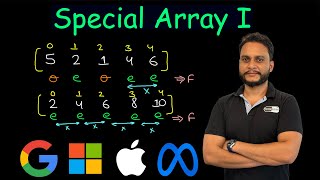


Techdose 5 mins
Special Array I | Leetcode 3151
Developer Docs 5 mins
Leetcode | 3151. Special Array I | Easy | Java Solution
Programming Live with Larry 3 mins
3151. Special Array I (Leetcode Easy)
Code Harmony 5 mins
LeetCode 3151 Special Array I | Modulo | Easy | Asked in Amazon
ShashTag 11 mins
Daily Leetcode - Special Array I - LC 3151
5 videos
did my crawler come up with invalid videos ? drop me a line.
Solved On The Same Day
1 easy
- problem 3090: Maximum Length Substring With Two Occurrences
- problem 3152: Special Array II
3 solutions
May 25, 2024
Extra
There are a few extra pages giving you some insights into my setup:
- Tech Stack - my development environment and tools
- AI - how AI helped me create this website (NOT solving the problems)
- Progress - progression over time
- Quality - code quality